 01
01Chemistry brief
We start with the substrate, the shade target, and the end use. Cotton knit, polyester print, viscose woven: each one changes the formulation.

Pigment emulsions, reactive and direct dyes, textile auxiliaries. Built for mills that need a colour to land the same way every batch, every season.
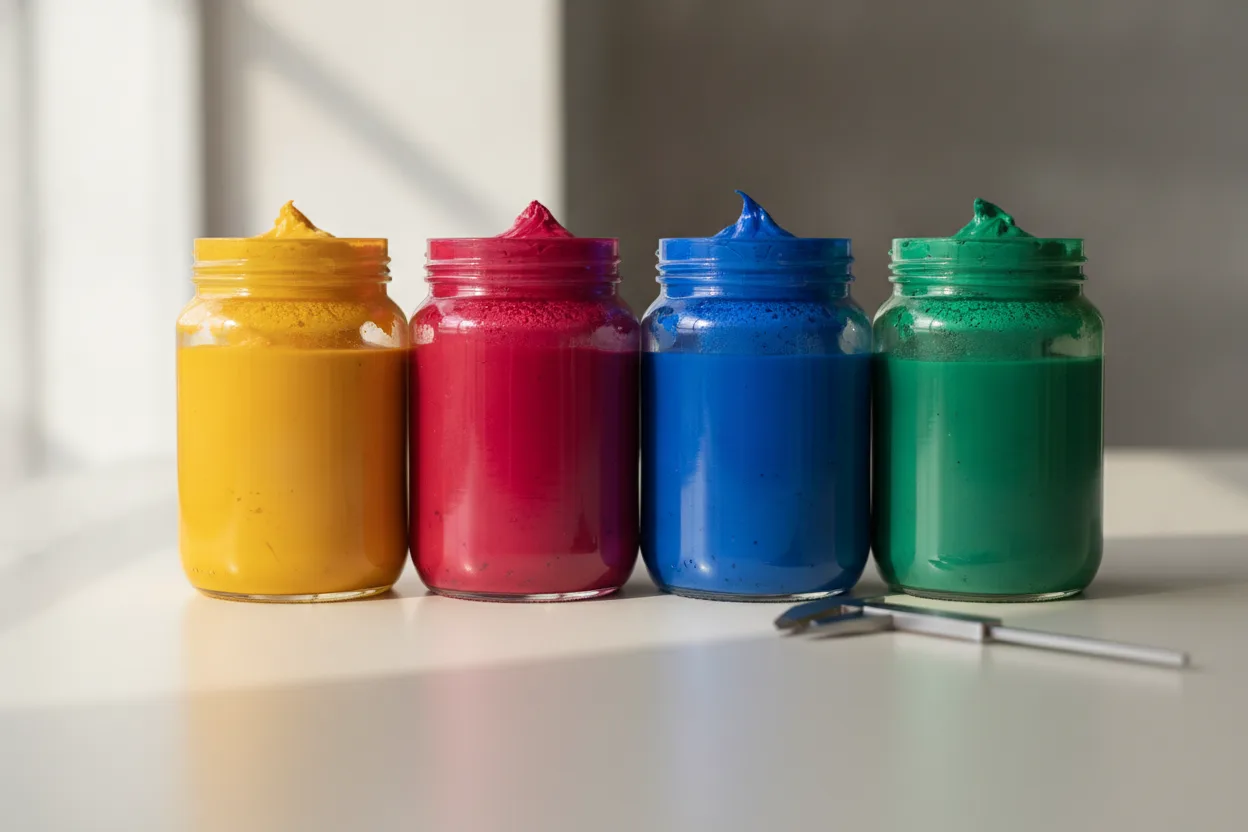
A colour house, run by the family that started it.
The Mehta family has manufactured pigments and dyes from Ahmedabad since 1992. Three decades on, the company still works out of Sarangpur, still tests every lot by hand, and still answers the phone when a mill calls about a shade.
Today the catalogue covers four working areas: pigment emulsions for textile printing, direct and reactive dyes for cellulosic fibres, pre-treatment and dyeing auxiliaries, and print-paste chemistry. Six product families, around fifty SKUs, all made in-house.
What customers come back for is consistency. The same red in March prints the same in October. Samples ship in days, not weeks. And the technical conversation happens with the people who actually formulate the product, not a sales desk.
By the numbers
of pigment manufacture, since 1992
across six product families
of pigment, held in stock
every lot, in-house, before despatch
Six product families, around fifty SKUs, every one matched and lot-tested in-house. Pick a family to see the shade range and the codes that ship in drums next week.
Water-based colour for textile printing.
Fourteen shades of water-based pigment emulsion, matched and held to a single tinctorial standard. Each batch is filtered, viscosity-checked, and run against the previous lot before it leaves the floor.
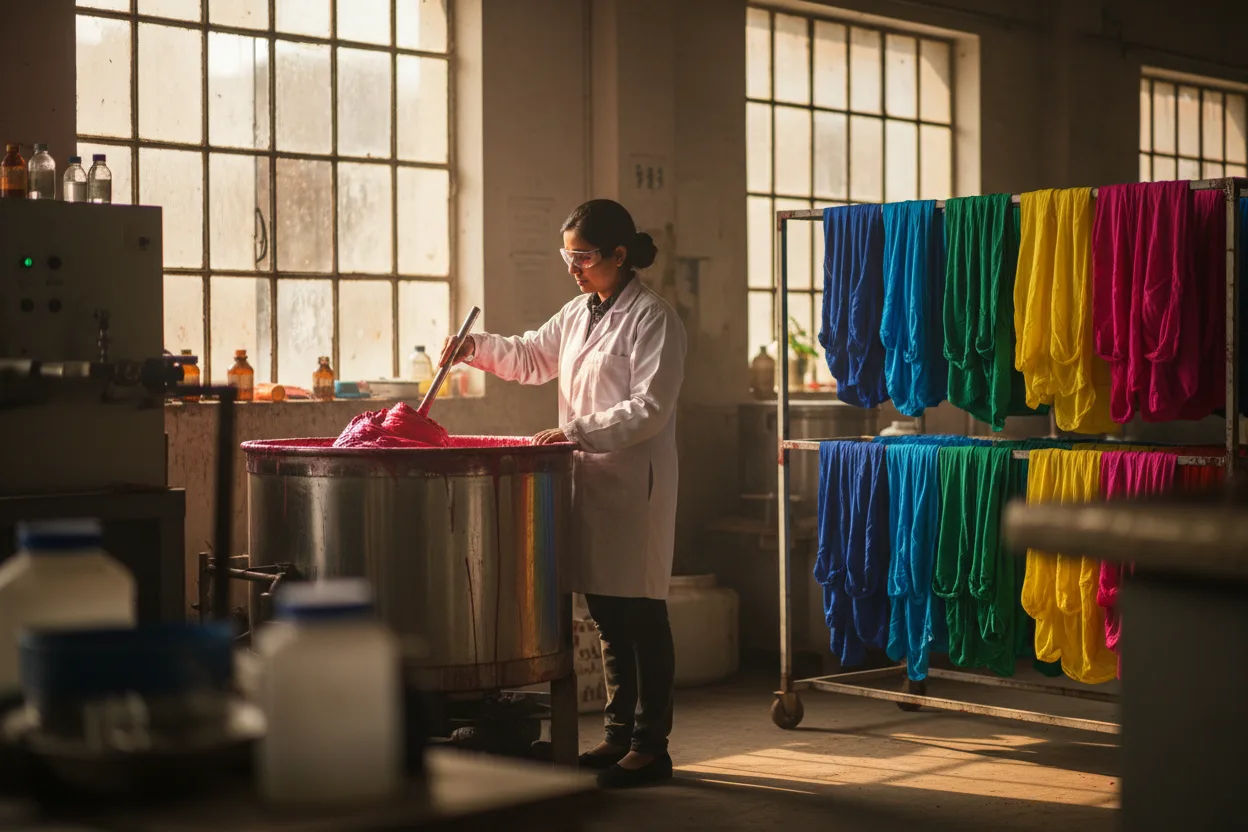
Every shade follows the same path from brief to despatch. The sequence is short on purpose: fewer hand-offs, fewer places for a colour to drift.
 01
01We start with the substrate, the shade target, and the end use. Cotton knit, polyester print, viscose woven: each one changes the formulation.
 02
02A bench-scale batch is made, dyed or printed on the customer's fabric, and read against the target swatch under D65.
 03
03Once the trial is signed off, the formula scales to the production reactor with the same raw material lots and the same operator.
 04
04Every finished lot is checked for shade, viscosity, pH, and fastness before it is allowed to leave the floor.
 05
05Drums are labelled with batch number and date, shipped on the agreed schedule, and followed up by a call once the mill has run them.
01We start with the substrate, the shade target, and the end use. Cotton knit, polyester print, viscose woven: each one changes the formulation.
02A bench-scale batch is made, dyed or printed on the customer's fabric, and read against the target swatch under D65.
03Once the trial is signed off, the formula scales to the production reactor with the same raw material lots and the same operator.
04Every finished lot is checked for shade, viscosity, pH, and fastness before it is allowed to leave the floor.
05Drums are labelled with batch number and date, shipped on the agreed schedule, and followed up by a call once the mill has run them.
The Mehtas
Founder, Operations
Bharat started the company in 1992 and still runs the manufacturing floor in Sarangpur. He sets the formulation standards, signs off on every shade lot, and handles raw material sourcing.
Second generation, Customer and Exports
Rishabh has stepped in alongside his father to look after customer accounts, technical queries, and outbound shipments. He is the person on the other end of the phone when a mill needs a colour matched or a sample resent.
Sample requests welcome
Send a swatch or a Pantone reference. We will quote the trial and ship a sample drum.
Talk to us
The two numbers below ring the founders directly. For shade matching, samples, or a price list, either one works. Email is fine for documents and POs.